

Il Faro delle Formiche
Tuscan Archipelago, Italy · 14.8 acres
About This Island
A 1901 Italian Royal Navy lighthouse, on a 6-hectare uninhabited islet in the Tyrrhenian Sea, ten nautical miles west of the Tuscan coast, restored as a two-bedroom private retreat for up to four guests.
This is not the usual private-island proposition. Il Faro delle Formiche is small, contemplative, and deliberately spare. The pitch is not luxury in the sense of excess, but luxury in the older European sense of having access to a place no one else does. For two nights, a week, or longer, you have a working Italian lighthouse and its keeper's house entirely to yourself, on an islet so small that you can walk its perimeter in twenty minutes.
The Italian Navy still operates the light. Every six seconds, all night, the lantern emits a single white flash visible eleven nautical miles out to sea. The flash above your bedroom is the working maritime signal it has been for over a century.
The Lighthouse
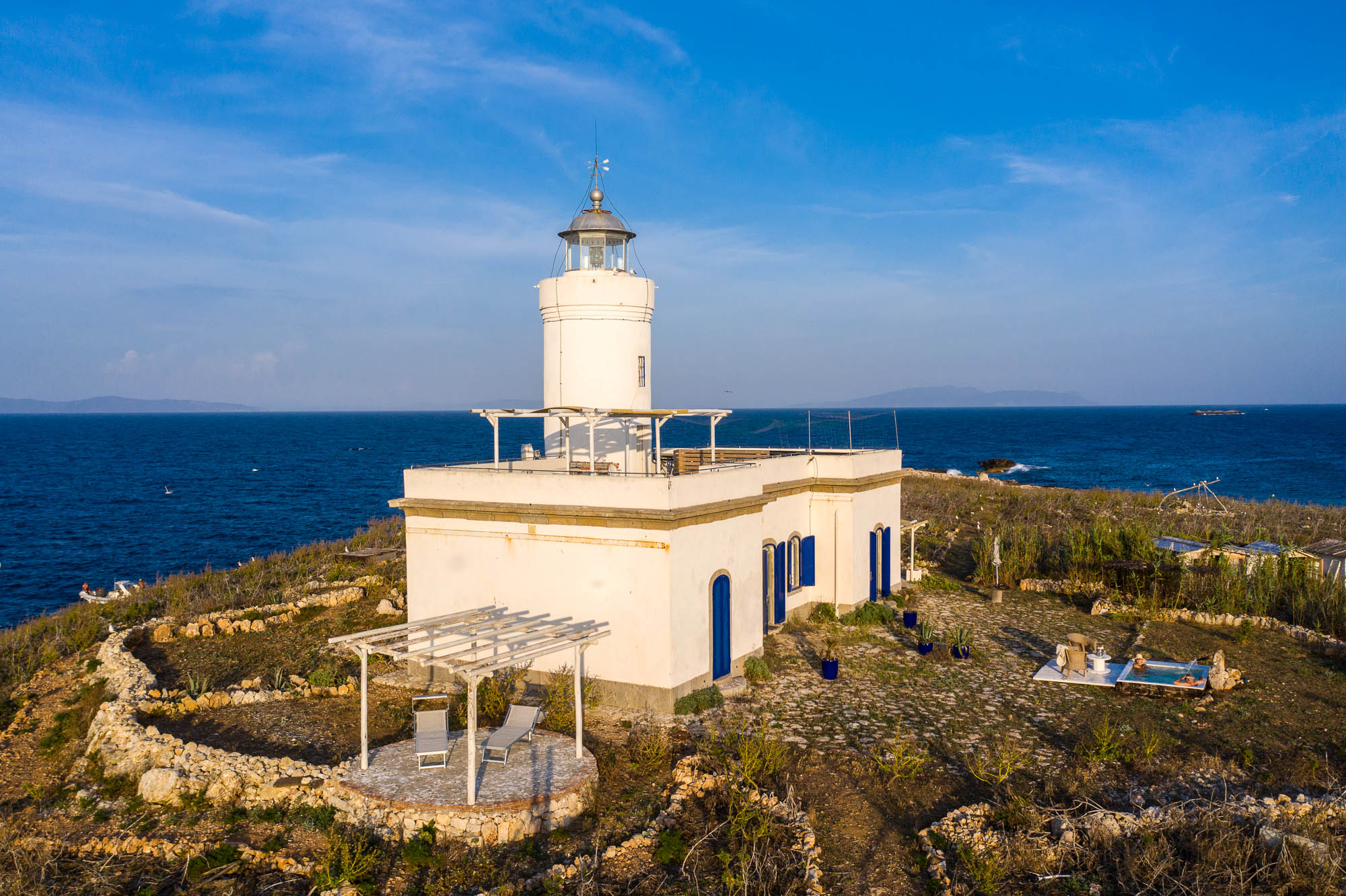
The Faro delle Formiche di Grosseto was built in 1901 by the Regia Marina (Italian Royal Navy) on the largest of three small islets known collectively as the Formiche di Grosseto, the Ants of Grosseto, named for their sharp profiles rising from open sea. The tower was restored in 1919 and has remained in continuous operation since.
The structure consists of a cylindrical white masonry tower, 12 metres tall, attached to the front of a single-storey rectangular building that housed the lighthouse keepers before the light's automation. The focal height of the lamp is 23 metres above sea level, with a LABI 100W lamp powered by solar panels, emitting one white flash every six seconds visible up to 11 nautical miles. The light is identified by the Italian Navy under the code number 2136 E.F.
The keeper's house, no longer needed for its original purpose since the light's automation, was restored under a 2016 Italian government program that grants long-term concessions of historic lighthouses to private operators committed to their preservation and adaptive reuse. The concession for Faro delle Formiche was awarded in 2017 to a consortium named Sea Turtles Friends of Grosseto, with a €365,000 investment to convert the structure into the contemporary hospitality experience it is today.
The result is one of only a small number of working historic Italian lighthouses available for private exclusive-use rental anywhere on the Mediterranean.
The Setting
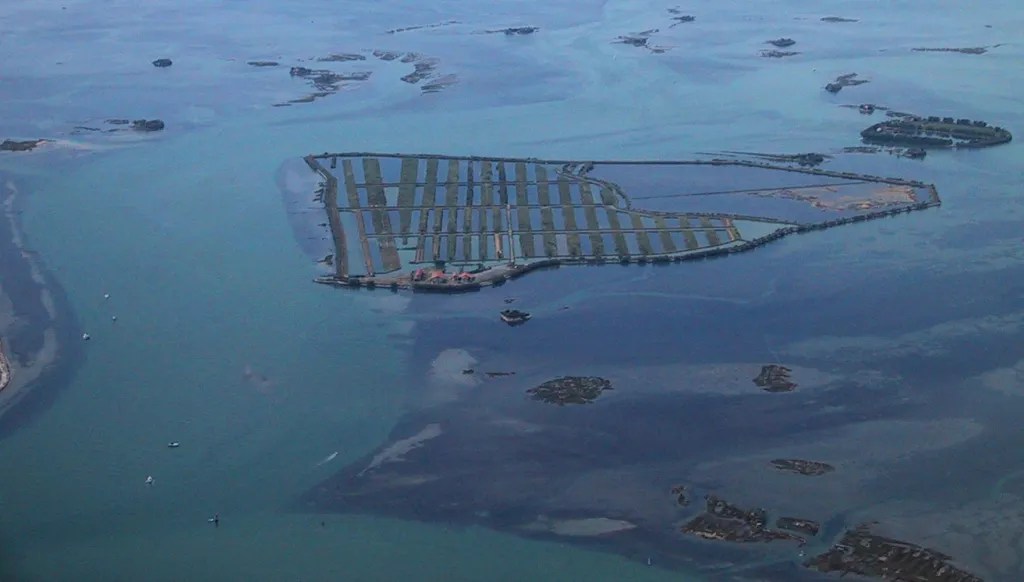
The Formiche di Grosseto are three uninhabited islets in the Tuscan Archipelago, the same chain of islands that includes Elba, Giglio, Pianosa, Montecristo, Capraia, and Gorgona. They sit nine nautical miles (15 km) southwest of Marina di Grosseto, on the western coast of Tuscany, with the Tyrrhenian Sea opening to the south and west toward Corsica and Sardinia.
The wider area around the property:
- The Tuscan Archipelago National Park (Parco Nazionale dell'Arcipelago Toscano) is the largest marine protected area in Europe, covering more than 60,000 hectares of sea and 17,000 hectares of land across the seven islands of the archipelago.
- The Maremma Natural Park, on the mainland directly opposite the islets, is one of the most ecologically pristine stretches of the Italian coast, with rolling oak forests, wild horses, the butteri (the traditional Tuscan cowboys), and the Etruscan and Roman archaeological remains that thread through the Maremma's long history.
- The Costa d'Argento, the Silver Coast, runs south from the property toward Monte Argentario, with the medieval fishing town of Porto Santo Stefano, the small borgo of Porto Ercole, and the chain of inland Maremma hilltop villages.
- The waters of the Formiche are some of the most prized diving in central Italy, with the islets rising sharply from a 100-metre seafloor, creating dramatic underwater vertical walls populated by groupers, octopus, moray eels, lobsters, and the resident Mediterranean marine life that has made this a destination for serious divers from across Europe.
The Accommodation
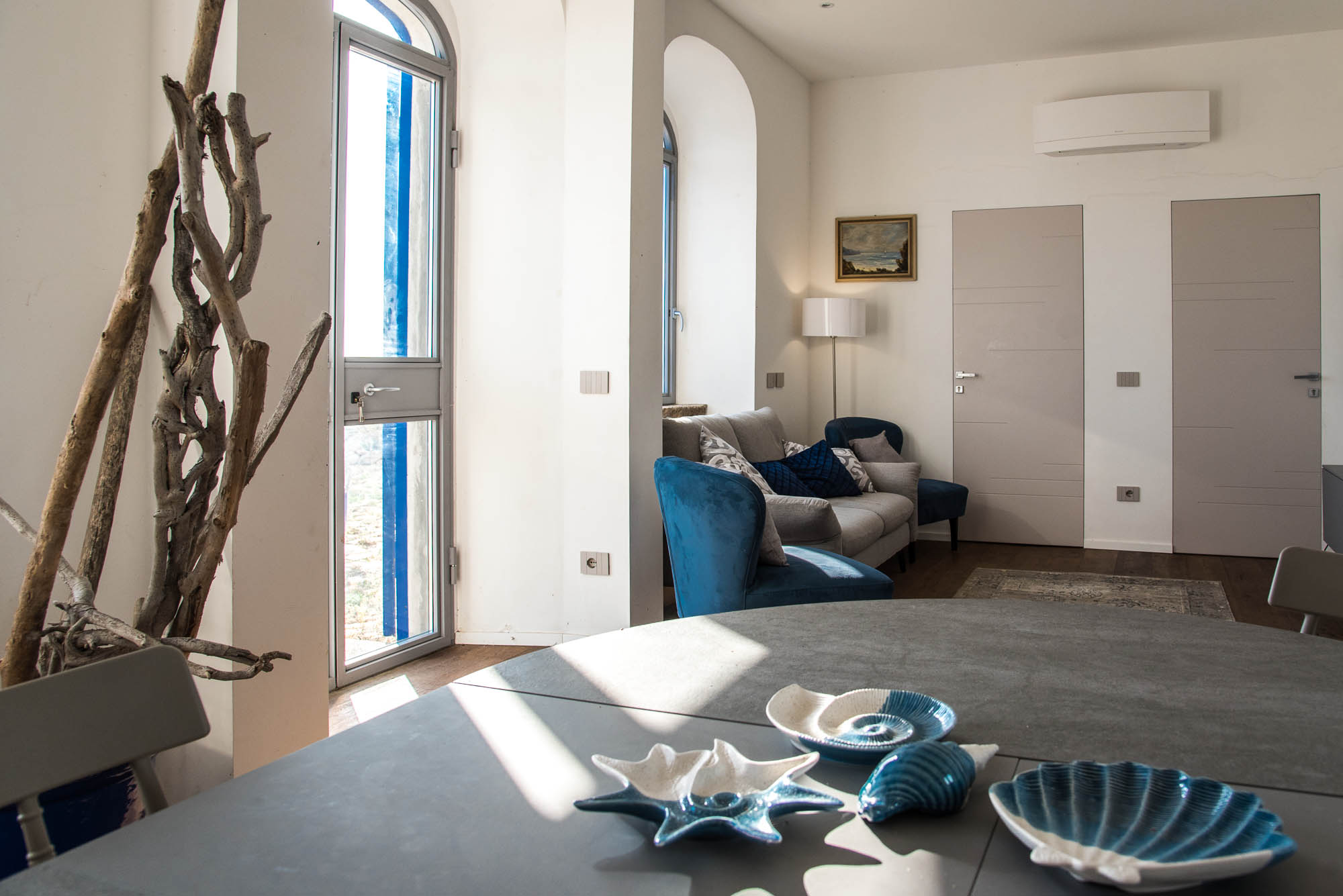
The renovated keeper's house holds a single 80-square-metre suite, the entire occupied space of the lighthouse complex.
- Two ensuite bedrooms, each with a king bed, rain showers, fine linens, and air conditioning
- A central living area with comfortable seating, a small bar corner, and a library of bilingual books on lighthouses
- A dining area for up to eight guests
- Modern amenities including 42-inch smart television with satellite channels and WiFi
- A private outdoor terrace, equipped with umbrella and loungers, with panoramic views across the Tyrrhenian
A small touch that captures the property's character: on the bedside table, in place of the bible found in most Italian guesthouses, the next guest will find a pair of binoculars. The intention is clear. The divine on Formiche is in the small universe surrounding you, not in pages on a shelf.
The interior fit-out has been kept understated and authentic. The aesthetic is the restored Italian maritime building, not the resort-villa idiom imported from elsewhere.
The Outdoor World
The 6-hectare island is the second part of the rental, and arguably the more important one.
The terrain is windswept, low, and sun-shaped. Dry-stone walls thread through the landscape, traces of the lighthouse keepers and the generations of fishermen who took shelter here. Winding paths lead between hidden corners. Hammocks are slung in protected hollows. A shaded gazebo holds a book and a glass for the long afternoon hours.
In spring, the island bursts into colour. The vegetation transforms from its winter brown into a riot of wildflowers and aromatic herbs:
- Wild fennel scenting the paths
- Sea lavender along the rocky margins
- Limonio delle Formiche (Limonium etruscum), a Tuscan endemic statice that flowers in dense violet drifts each spring and exists in only a handful of Italian coastal locations
The fauna is the seabird life of the Tyrrhenian: yellow-legged gulls, cormorants, shearwaters, and the occasional rare Eleonora's falcon on migration. The waters around the islet are a designated Special Protection Area under European nature conservation law.
There is a natural thermal spring on the island, the waters of which emerge from the ground at approximately 38.7°C. Day or night, guests can immerse themselves in the warmth of this hidden feature, under a sky that, on the offshore Tyrrhenian, is genuinely dark and dense with stars.
A Day, In Sketch
Mornings on Formiche start with the lighthouse's silence. The 5 a.m. flash that has worked all night continues, but inside the keeper's house the only sound is the Mediterranean wind on stone and the distant call of gulls.
Coffee on the outdoor terrace. The sun rising over the Maremma coast to the east. The first light catching the white tower of the lighthouse above you.
The day shapes itself slowly. There is no schedule on Formiche. There is no boat that comes to pick you up at a fixed hour. There is nowhere to be by lunch.
What the day might hold:
- A long walk around the 6-hectare perimeter, twenty minutes if you walk straight, two hours if you stop for every wildflower and every changing view of the sea
- A swim off the rocks, into water clear enough to see the seabed at depth
- A scuba dive for guests certified or willing to learn, on the dramatic vertical walls of the Formiche, one of central Italy's finest dive sites
- A read in the gazebo, with the lighthouse library's curated bilingual collection
- A sail or boat excursion to the neighbouring islands of the Tuscan Archipelago: Giglio, Pianosa, Elba, or the more remote Montecristo
- An afternoon in the thermal pool, with the Tyrrhenian breeze and the sun coming through the rocks
- Nothing. The hammock. The umbrella. The sound of the sea.
Lunch and dinner are prepared by the on-island chef, with menus calibrated to the guest party's preferences and built around fresh local Mediterranean ingredients: seafood from the Maremma fleet, vegetables and olive oil from the Tuscan mainland, wines from the surrounding Bolgheri and Maremma appellations that have become some of Italy's most respected over the past two decades.
Evenings are the lighthouse's own theatre. The Tyrrhenian sunset turns the white tower gold, then pink, then violet. The light begins its work for the night. The stars come out over an offshore Italian sky with no settlement visible in any direction. Dinner is on the outdoor terrace, or inside if the wind is up, with the lantern flashing rhythmically above.
Events and Configurations
The property's standard configuration is up to four overnight guests in the two ensuite bedrooms, with a minimum stay of two nights.
For weddings, elopements, anniversaries, and small private celebrations, the island accepts day events of up to twenty guests, with the chef preparing tailored menus and the ceremony held on the open terrace, in the gazebo, or at the foot of the lighthouse itself. For couples wanting one of the most distinctive and most authentic wedding venues in Italy, the lighthouse offers the kind of setting that almost no other Italian property can.
The minimum two-night stay structure allows a married couple to take the lighthouse for their wedding day and the night after, with their guests arriving and departing by chartered transfer from Marina di Grosseto.
Access
- By boat from Marina di Grosseto: approximately 40 minutes by powered transfer (typically the Nibbio vessel or equivalent), departing from the port at Marina di Grosseto on the mainland
- By private yacht: the property has a small dock for guest arrivals on Formica Grande; mooring conditions are weather-dependent
- From Rome (Fiumicino, FCO): approximately 2.5 hours by car to Marina di Grosseto, with a wide range of direct international connections from Rome
- From Florence (Peretola, FLR): approximately 2 hours by car to Marina di Grosseto
- From Pisa (PSA): approximately 2 hours by car
- From Milan, London, Paris, or German hubs: direct flights into Rome, Florence, or Pisa, followed by mainland road transfer
A guest leaving London or Paris in the morning is at the lighthouse for dinner.
A Note on Weather
Formiche di Grosseto is an offshore Italian islet in the Tyrrhenian Sea. The boat crossing is straightforward in good conditions and is occasionally suspended in adverse weather. The property operates between April and October, the standard Italian operating season for Tyrrhenian offshore properties, with the spring wildflower months and the long summer evenings widely regarded as the peak of the experience.
The lighthouse continues its work in all seasons. The hospitality operation does not.
What Il Faro delle Formiche actually rents is a working piece of Italian maritime heritage on a 6-hectare uninhabited islet, set in the largest marine national park in Europe, accessed by a 40-minute boat journey, staffed for a maximum of four overnight guests, and operating under a long-term concession from the Italian Navy.
For the couple, the small family, or the wedding party that has decided their next celebration should happen somewhere that almost no one else can, this is the booking.
Everything You Need To Know
Italy
Detailed jurisdiction data for Italy coming soon. Browse our buying guides for general information.