

Middle Calf Island
Roaringwater Bay, West Cork, Ireland · 64 acres · Freehold
About This Island
The school on Middle Calf Island was built in 1835. It served the children of the six families who lived on the island and also took pupils from the neighbouring islands of West Calf, East Calf, and Cape Clear, who arrived by boat each morning. The population of Middle Calf in 1841, the year before the Great Famine began, was thirty-nine.
The school closed eventually. The families left, one by one. The last family departed in 1937, after which the island has remained uninhabited.
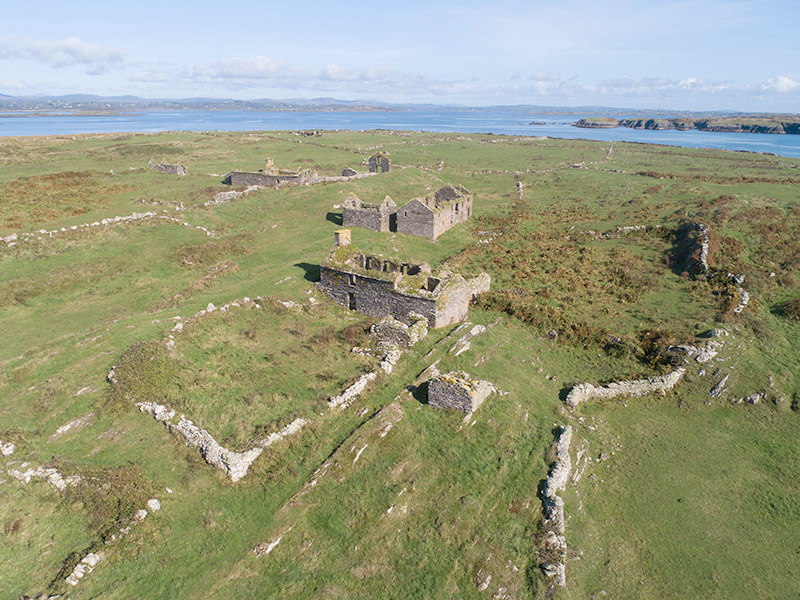
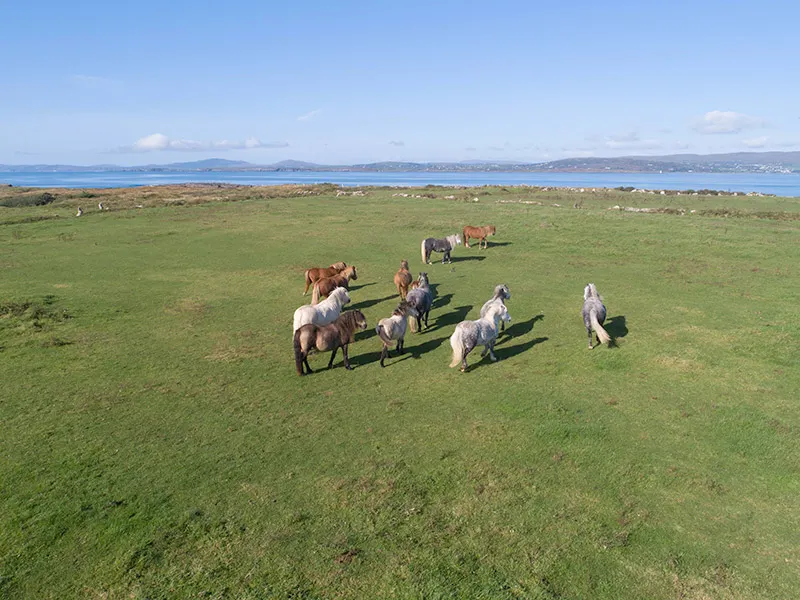
Today, Middle Calf is a 64-acre uninhabited private island in the middle of Roaringwater Bay, off the coast of West Cork. The ruined walls of four dwellings, the outbuildings, the field divisions, and the school's stone foundations are still on the land. A herd of approximately twenty-five Kerry Bog Ponies grazes the island year-round, the only continuous inhabitants left.
The Land
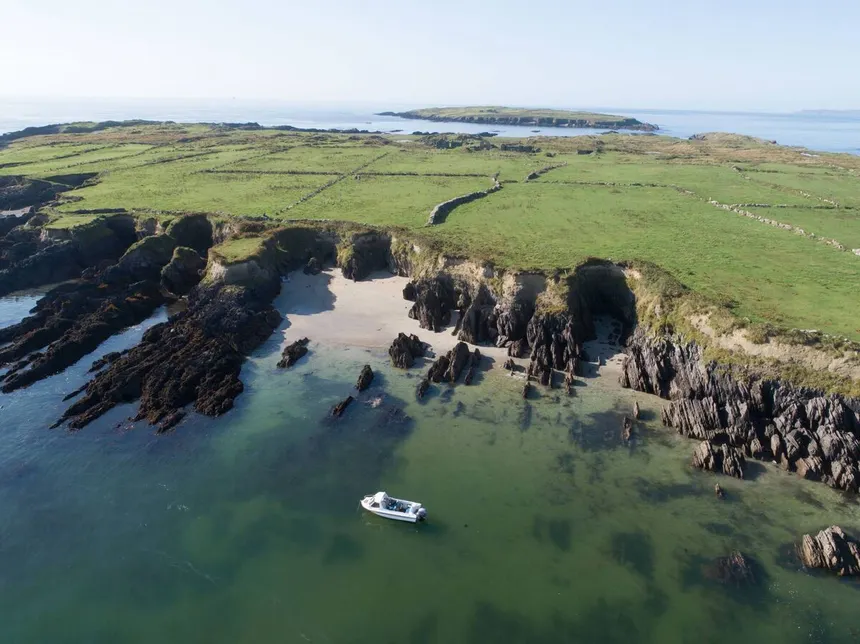
Sixty-four acres of West Cork coastal grassland, with the characteristic profile of a Roaringwater Bay island: rocky ocean margins, sheltered green interior, the stone walls of generations of small holdings dividing the land into fields that the ponies now graze across.
The shoreline carries several beaches, with the soft sand that the Atlantic edge of Ireland produces in its quieter coves. Several small freshwater lakes are dotted across the interior, supporting the year-round water supply for the ponies and the seabird populations that nest along the cliffs.
The buildings on the island are ruins, in varying states of preservation:
- Four ruined dwellings, the homes of the six families documented on the island in 1841 and through the late 19th century
- Outbuildings associated with the agricultural use, in similar condition
- Stone walls dividing the historic fields, mostly intact, marking the centuries-old subdivisions of the land
- The remains of the 1835 school building, with its specific historical significance to the wider Roaringwater Bay community
The island does not have a pier. Boats land at the beach, in the traditional manner.
The Kerry Bog Ponies
The current population of the island is a herd of approximately twenty-five Kerry Bog Ponies, an endangered native Irish breed historically used to carry peat from Irish bogs back to the homesteads that burned it for fuel. The ponies are well-suited to the island's terrain: their small hooves cause minimal damage to grazed land, they thrive on the low-protein Atlantic grasses, and they survive Irish winters outdoors without supplementary shelter.
The herd's role on Middle Calf is dual. It maintains the grazed character of the land that the families' sheep and cattle once kept open. And it preserves a meaningful working population of a heritage breed that exists, globally, in very small numbers.
The herd is included with the property in the transaction, which is unusual in the private island market and reflects the operating ecological condition of the island.
In 2022, a documented expedition led by Jeremy Irons and the Crowley family relocated six ponies from this herd to Mannin Island for breed-management purposes, a public moment that placed Middle Calf briefly into the wider Irish conservation conversation. The herd has remained a defining feature of the island's contemporary character.
A Note in History
Roaringwater Bay was, in the 19th century, a site of one of the most significant tenant-rights political struggles in Irish history. The Land War of the 1880s and 1890s pitted Irish tenant farmers against absentee landlords across the country, and the islands of Roaringwater Bay were at the local centre of that struggle.
In September 1890, William O'Brien MP, the founder of the National League and one of the most consequential figures in the Irish nationalist movement, held a political meeting on Middle Calf Island in support of tenants who had been evicted from the neighbouring Castle Island. The meeting was part of the broader campaign that eventually produced the Land Purchase Acts of the 1890s and 1900s, the legislation that transferred ownership of Irish land from landlords to tenants and laid the economic groundwork for Irish independence in the 20th century.
The visible heritage of Middle Calf, the school, the dwellings, the stone walls, sits at the centre of one of the most consequential periods in modern Irish political and social history.
The Setting
Roaringwater Bay is part of Carbery's Hundred Isles, the West Cork archipelago of more than 100 small islands that has been one of the most distinctive coastal landscapes of southern Ireland for centuries. The bay opens to the Atlantic, with the protected interior waters running between Cape Clear (the southernmost inhabited point of Ireland), Sherkin Island, Heir Island, Castle Island, Horse Island, the Calves, and the Skeam islands.
The wider region is one of the most active private island markets in Europe. Recent neighbouring island transactions include:
- Horse Island (157 acres), reported sold in 2020 to Cypriot businessman John Renos
- Castle Island (123 acres), reported sold in 2020 to an English buyer based in France
- West Calf Island, the western sibling of Middle Calf, currently also on the private island market
The pattern of acquisitions reflects the underlying logic of West Cork's appeal: the combination of genuine Atlantic seclusion, the protected interior waters of the bay, the historic Irish coastal landscape, and the relative accessibility of West Cork by road from Cork City and air from Cork Airport.
Schull, the mainland village 5.7 kilometres north of the island, is one of West Cork's most refined small communities, with the Heron Gallery, the Sailing Cookery School, a Michelin Guide-recognised restaurant scene at Hackett's, Bushe's Bar, and the Schull Regatta in late summer. The village is the boat-arrival point for most of the Roaringwater Bay islands.
Cape Clear Island, 3.8 kilometres south, is Ireland's southernmost inhabited point, a Gaeltacht (Irish-speaking) community with the Bird Observatory, the Cape Clear Storytelling Festival, and the cultural depth that the most remote habitable parts of Ireland have always preserved.
Development Considerations
The expired Outline Planning Permission for the reconstruction of a ruined dwelling, for use as a dwelling, and for the reconstruction of outbuildings for ancillary use, is a meaningful starting point but is no longer in force. A new owner will need to renew the planning application through Cork County Council, working within the Irish planning framework that governs heritage coastal sites.
This process is real, and a serious buyer should understand it. Irish planning for the reconstruction of historic structures on offshore islands typically requires:
- Engagement with Cork County Council planning department
- Archaeological assessment of the existing ruins
- Compliance with the Irish heritage protection framework where applicable
- A timeline that can run 12 to 24 months for a clean approval, longer for complex cases
That said, the precedent of the earlier outline permission is constructive. Cork County Council has, on the record, approved the principle of reconstructing a dwelling on the island. A renewed application that respects the heritage character and the modest scale of the existing footprint should follow a manageable path.
Three positions are credible for the next owner:
A private retreat. A reconstructed dwelling on the foundation of one of the four original homes, restored using stone consistent with the existing fabric, as the primary occupancy on the island. The herd remains. The island remains substantially in its current ecological condition.
A heritage estate with conservation focus. A more substantial restoration of multiple ruins, paired with a formal conservation management plan for the Kerry Bog Pony herd, the grassland, and the heritage structures. This is the position that aligns with the depth of cultural history the island carries.
A continued working agricultural holding. Without further building, the island can continue in its current use as a Kerry Bog Pony grazing operation, with the option to develop residential infrastructure deferred or declined entirely. For a buyer whose primary interest is the heritage and the herd rather than residential development, this is the lowest-touch option.
A Note on Irish Ownership
Ireland is a member of the European Union, and EU citizens purchase Irish property on the same terms as Irish nationals. Non-EU buyers are welcome to acquire Irish property under the country's open foreign ownership framework, with the standard transfer process handled through an Irish solicitor and the Property Registration Authority.
Ireland's property law is among the most transparent in Europe. The land registry is digital and comprehensive. Title is unambiguous. The transaction process is straightforward by European standards. Irish residency does not flow automatically from property purchase, but a property at this scale pairs naturally with the kind of seasonal or part-year residence that an international buyer is likely to operate.
Access
- From Cork International Airport (ORK): approximately 1 hour 45 minutes by car to Schull, with direct flights from London, Amsterdam, Paris, Frankfurt, Barcelona, and other European hubs
- From Dublin Airport (DUB): approximately 3 hours 30 minutes by car to Schull
- From Shannon Airport (SNN): approximately 2 hours 30 minutes by car
- From Schull to the island: approximately 5.7 kilometres by boat
- From Cape Clear to the island: approximately 3.8 kilometres by boat
- From the West Calf Island anchorage: 500 metres
A buyer flying into Cork in the morning is on the island by lunch.
The Position
Middle Calf Island is the rare West Cork private island that combines genuine acreage (64 acres), a clean freehold title, complete privacy in one of Ireland's most beautiful coastal landscapes, and a layered cultural and ecological heritage that makes the property more than a piece of coastal land. The 1835 school, the four ruined homes of the six families who lived here until 1937, the herd of endangered Kerry Bog Ponies, and the 1890 Land War political meeting that linked this specific island to the chain of events that produced modern Ireland, give Middle Calf a depth of human and natural history that newer luxury private islands cannot replicate.
For a buyer with a thoughtful position on Irish heritage, on Atlantic conservation, or on simply owning a piece of West Cork at a scale that allows for meaningful long-term restoration, Middle Calf is the property where the work of the next century begins on foundations that the previous two centuries left ready to receive it.
Everything You Need To Know
Ireland
Detailed jurisdiction data for Ireland coming soon. Browse our buying guides for general information.
More Islands In Ireland

Shore Island

Ardoileán, High Island, County Galway
