
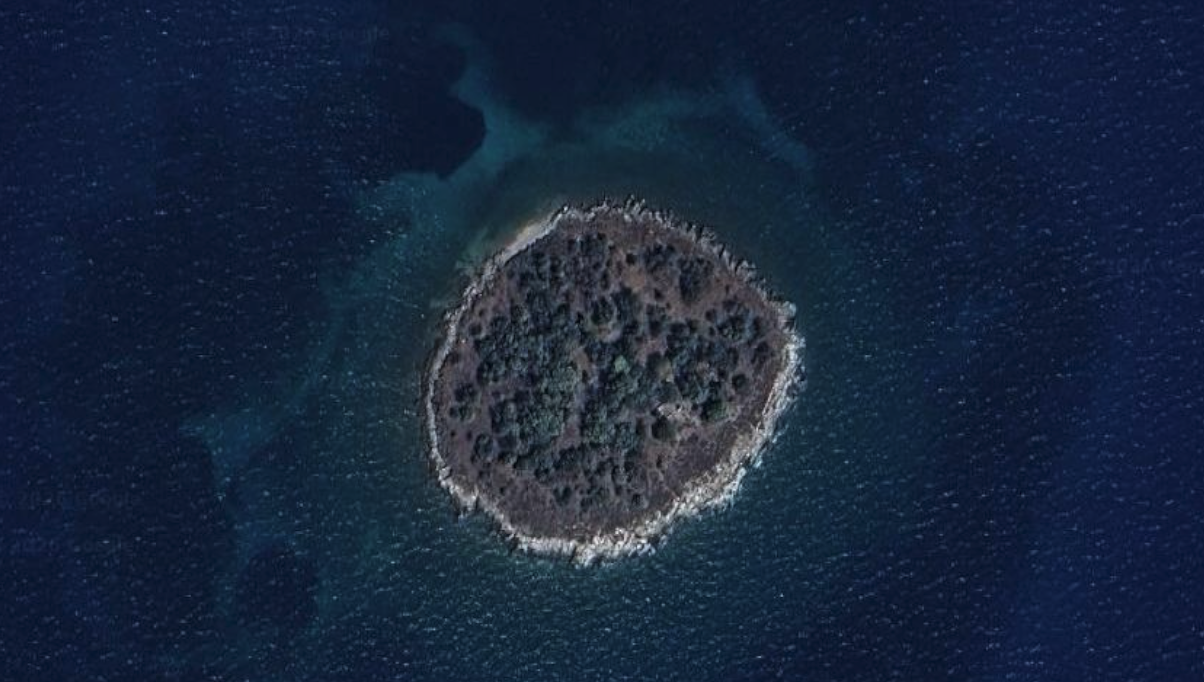
St. Athanasios Island
Corinthian Gulf, Greece · 2.6 acres · Freehold
About This Island
Itea, the small coastal town on the north shore of the Gulf of Corinth, sits 8 kilometres south of Delphi, the most important sacred site of the classical Greek world. For nearly a thousand years, the Oracle of Delphi spoke from the slopes of Mount Parnassos above this bay, and pilgrims from across the Mediterranean arrived by sea at the port of Kirra, immediately adjacent to modern Itea, before walking the sacred road inland to the temple of Apollo.
A short boat ride from Itea's shoreline, in the same water through which those pilgrims sailed, sits St. Athanasios Island.
The island is small, by design and by virtue. 10,811 square metres of private freehold ground, with the cultural and geographic context of one of the most consequential landscapes in European history at its doorstep.
The Land
The island carries the classical Mediterranean character of central Greece: low, rocky margins where the land meets the Gulf of Corinth; an interior of olive and pine trees that has the dry-summer perfume that has defined Greek coastal landscapes since the Bronze Age; and a small sandy beach along the northwestern coast where the prevailing summer breeze keeps the air mild even in August.
The terrain is largely flat, which is unusual among small Greek islands and which is what makes the property practical for thoughtful residential development. The 250-square-metre family residence that the pre-approved building permit has authorised can be sited to take advantage of the morning sun over Mount Parnassos to the north, the evening light across the Gulf of Corinth to the south, and the small private beach as the gentle daily access point to the water.
The seawater is the clear, marine-life-rich water of the Gulf of Corinth, which has been one of the most productive marine ecosystems of the eastern Mediterranean for as long as human records have tracked it.
The Cultural Context
Itea sits at the bottom of what was, for the better part of a millennium, the most important pilgrimage destination in the Mediterranean world.
Delphi, eight kilometres inland from Itea, was the seat of the Oracle of Pythia, the priestess through whom the god Apollo was believed to speak. From roughly the 8th century BC to the 4th century AD, Delphi was the religious and political centre of the Greek world. Greek city-states sent ambassadors to consult the Oracle before declaring war, founding colonies, or making major political decisions. The Pythian Games, second in prestige only to the Olympic Games of ancient Greece, were held at Delphi every four years. The site was inscribed by UNESCO as a World Heritage Site in 1987.
The temples, the treasury buildings, the theatre, the stadium, and the famous Sacred Way of Delphi survive today as one of the most photographed and visited classical sites in Greece. The slopes of Mount Parnassos rise directly behind Delphi, and the same slopes contain the modern Parnassos ski resort, one of the few in mainland Greece.
Galaxidi, a historic maritime port 15 minutes west by car from Itea, was one of the major Greek shipping towns of the 19th century and preserves its colourful neoclassical sea-captain mansions almost intact.
From St. Athanasios, looking inland to the north, the slopes that lead to Delphi are clearly visible. Looking south across the Gulf of Corinth, the mountainous coast of the Peloponnese forms the horizon. Looking west, the lights of Galaxidi mark the historic shipping town. Looking east, the bay opens toward the wider Corinthian Gulf and, beyond, the canal that connects to the Aegean.
This is one of the most culturally and visually layered private island positions available anywhere in Greece.
What Makes This Property Specifically Buildable
For a Greek private island, the combination of features here is unusual and worth understanding individually.
Full, unrestricted freehold title. Many Greek private islands carry encumbrances, partial titles, contested ownership shares, or municipal-claim portions. St. Athanasios is held in clean unencumbered freehold, which is the simplest legal structure available under Greek property law and the structure most welcoming to foreign acquisition.
Pre-approved building permit for a 250 sqm family residence. Greek planning approvals for new construction on small islands have historically been slow, expensive, and uncertain. St. Athanasios already carries an approved permit for a substantial single-family residence of approximately 250 square metres. The buyer of this property is not starting the permitting process; they are stepping into a permit that has already cleared the relevant Greek authorities.
Exemption from Natura 2000 area restrictions. The European Union's Natura 2000 conservation network covers a significant portion of the Greek coastline and severely constrains development in many designated areas. St. Athanasios is outside the Natura 2000 boundaries, which means the residence permitted under the existing approval can be built without the additional environmental impact assessments that designated areas require.
Forest certificate. Greek properties with significant tree cover often face complications under the country's forestry law, which can restrict the felling of native trees and the siting of buildings. St. Athanasios carries a forest certificate that has resolved the relevant classification questions.
The combined effect of these four conditions is unusual in the Greek private island market. Many small Greek islands look approachable on first read but reveal complications during due diligence that extend a project's timeline by years or block it entirely. St. Athanasios is the rare small Greek island where the legal and regulatory groundwork has already been done.
What This Island Is For
The size of St. Athanasios is the defining feature of its usability, and worth thinking about directly rather than apologetically.
At 2.6 acres, the property is too small to support a hotel, a resort, or a multi-villa development. It is also exactly the right size for what it is intended to be: a single family's private island residence, with the 250 sqm permitted residence as the primary house, the surrounding land as private gardens and olive grove, the small beach as the family's swimming and boating access point, and the Gulf of Corinth as the daily horizon.
For a buyer who has been thinking about owning a Greek private island but has been deterred by the scale and cost of the larger trophy properties on the market, St. Athanasios is the more accessible alternative position: a private island in genuinely exceptional geographic and cultural surroundings, sized to a household rather than to a corporation, with the building approvals already in place.
Access
- From Athens (ATH): approximately 2.5 hours by car west on the National Road, with international connections from every major European hub, plus New York, Dubai, Singapore, and Beijing
- From Athens by helicopter: approximately 45 minutes to the Itea waterfront
- From Patras International Airport (PAR): approximately 1.5 hours by car
- From Araxos Airport (GPA): approximately 92 km by road, seasonal European flights
- From Itea waterfront to the island: approximately 10 minutes by boat
- By private yacht: the Gulf of Corinth is fully navigable, with the Corinth Canal connecting to the Aegean Sea to the east; Itea is a standard stop on the Athens-to-Ionian sailing route
A buyer flying into Athens in the morning is on the island by lunch.
A Note on Greek Ownership
Greece is a member of the European Union, and EU citizens purchase Greek property on the same terms as Greek nationals. Non-EU buyers are welcome to acquire Greek property subject to bilateral reciprocity rules with the buyer's home country, which apply to nearly all major economies.
For a property of this scale and with this preparation, the transaction structure is straightforward by Greek standards: notarial transfer through a Greek notary, registration with the local cadastre, and the standard tax treatment for Greek residential real estate.
The Greek Golden Visa programme is available to qualifying non-EU investors and provides a residency pathway that pairs naturally with significant Greek property acquisition. A licensed Greek property lawyer should structure any transaction.
The Position
St. Athanasios is the rare Greek private island where the work has already been done. The freehold title is clean. The Natura 2000 exemption has been confirmed. The forest certificate is in hand. The building permit for a 250 sqm family residence is pre-approved. What remains for the next owner is the relatively pleasant work of choosing the architect, siting the house, and beginning construction on a private island at the foot of Delphi.
The Oracle's slopes are visible from the property. The Gulf of Corinth opens to the south. Galaxidi is 15 minutes west by boat. The ski resort of Parnassos is 45 minutes by car. Athens is 2.5 hours by road or 45 minutes by helicopter.
For the buyer thinking about a Greek family residence at the cultural and geographic heart of central Greece, this is the position from which to build it.

