
Isla del Barón
Mar Menor Lagoon, Murcia, Spain · Up to 10 guests · 7 bedrooms
Staff Included
- Private Chef
- Housekeeper
- Caretaker
Amenities
- Dock
About This Island
Isla del Barón is an extinct volcano in the middle of a saltwater lagoon, and it has belonged to the same family for five generations.
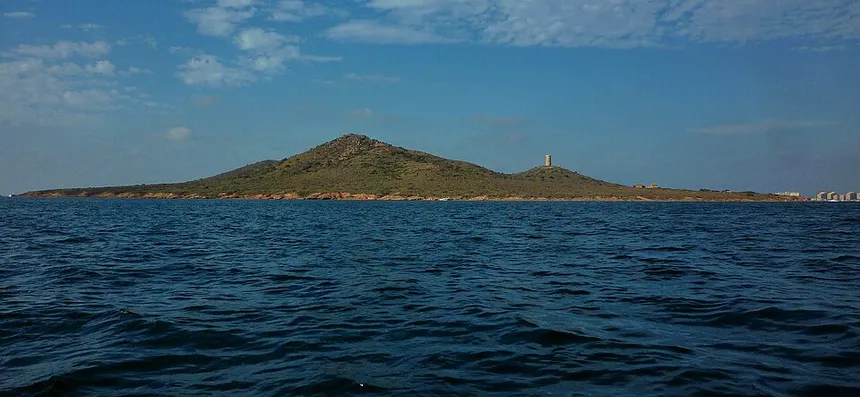
The island, also called Isla Mayor, sits almost exactly in the centre of the Mar Menor, the largest saltwater lagoon in Europe, on the Murcian coast of southeastern Spain. It is the largest island in the lagoon and in the entire Region of Murcia, at roughly 232 acres, and its distinctive conical shape is the legacy of the small stratovolcano that the entire island is built on. A heavily eroded crater is still visible at the summit, 104 metres above the lagoon.
The island is a private nature and wildlife reserve, rented for exclusive stays, with accommodation in a five-story circular tower, a set of cottages, and a hunting lodge.
The Island
The whole of Isla del Barón is an extinct volcanic cone, with two smaller secondary cones on its flanks and the main eroded crater at the top. The geology gives the island its near-perfect round perimeter and its dramatic profile rising from the flat water of the lagoon.
The island is a designated nature reserve and one of the most ecologically significant sites on the Murcian coast:
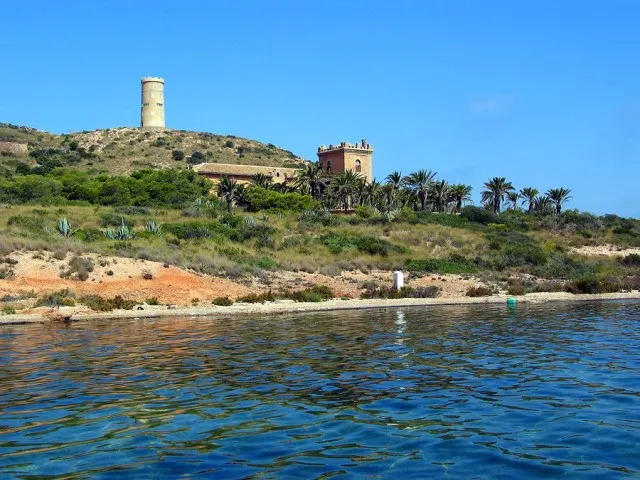
- A forest of Mediterranean dwarf palms (palmitos) that is considered unique in Europe, the only one of its kind on the continent
- A Special Protection Area for Birds (ZEPA / SPA) under the European Natura 2000 network, hosting a rich diversity of bird life, with falcons among the most notable residents
- A herd of Barbary sheep (mouflons), originally introduced from Sardinia in the 19th century, that graze the island's slopes
- Original Mediterranean maquis vegetation, preserved in a condition increasingly rare along the developed Spanish Mediterranean coast
The owners have dedicated the island to ecology and sustainability, with the bird populations and the rare palm forest as the focus of its conservation. A stay on Isla del Barón is a stay inside a working private nature reserve.
The coastline is rocky, with a number of small protected beaches tucked into its margins. The summit and the upper slopes offer panoramic views across the entire Mar Menor, the thin sandbar of La Manga that separates the lagoon from the Mediterranean, and the Murcian mainland.
The Palace and the Tower
The architectural history of Isla del Barón is unusually rich for a small Spanish island.
The centrepiece is the Baron's house, a Neo-Mudéjar palace built in the 1870s for Julio Falcó d'Adda, the Baron of Benifayó, an Italian aristocrat connected to the House of Savoy and to the Spanish royalty of his era. The palace was designed in the same idiom and with similar materials to the Hotel Victoria in the city of Murcia, and it has the character of a small castle: towers, battlements, a park, and two grand doors, one of which faces directly to the sea. In its prime it held a large library, artillery rooms, offices, and its own pier.
The five-story circular tower, the property's most distinctive rentable structure, was added in the 1950s after the death of the baron, designed by a noted architect of the period. The tower's circular rooms rise through five levels, each opening to views across the island's volcanic landscape and the lagoon beyond. The tower holds three bedrooms with en-suite bathrooms, two living rooms, and a kitchenette, distributed across its five floors.
The tower is not directly on the coast. It sits on the higher ground, with the nearest beach a 20-minute walk away through the island's reserve, which is part of its character: this is an island where the accommodation is woven into the landscape rather than lined up along the shore.
The Accommodation
The rentable accommodation on the island comprises three distinct structures, totalling seven double rooms and accommodating up to ten adults. The structures can be taken together for a single party with the run of the whole island.
- The Tower, the five-story circular structure, with three en-suite bedrooms, two living rooms, and a kitchenette across five levels
- The Cottages, painted in the traditional Mediterranean palette of indigo blue and terracotta
- The Hunting Lodge, in the same indigo-and-terracotta colour scheme
The island offers both self-catering and full-board options, with all meals available at additional cost. For a party wanting the run of a private Spanish island with the option of catered service, the structure is flexible to the group's preference.
The Mar Menor
The Mar Menor is one of the most distinctive bodies of water in Europe: a shallow saltwater lagoon of approximately 170 square kilometres, separated from the Mediterranean by La Manga, a 21-kilometre sandbar. The lagoon is warmer, calmer, and saltier than the open Mediterranean, which has made it one of the most popular water-sports and family-holiday destinations in Spain for generations.
For a guest on Isla del Barón, the lagoon is the playground. The island's activity offering includes:
- The use of a yacht and a sailing boat
- Latin sail (the traditional lateen-rigged sailing of the Mediterranean)
- Windsurfing, snorkelling, rowing, and rod fishing
- Access to three championship golf courses at the nearby La Manga Club, one of Europe's most established golf and sport resorts
The lagoon's shallow, protected water makes it ideal for less confident swimmers and for families, while the proximity to the open Mediterranean across La Manga opens the full range of coastal activity.
The Family
Isla del Barón has been owned by the Figueroa family for five generations. The island was acquired in 1899 by José Ignacio Figueroa Mendieta from the heir of the Baron of Benifayó, the Italian aristocrat whose Neo-Mudéjar palace still crowns the island. The current custodian is a direct descendant.
The history of how the island came to carry the baron's name is one of the more colourful stories in Spanish island lore. The Baron of Benifayó, an Italian connected to the House of Savoy, served a sentence on the island when it functioned as a prison of the Spanish Navy, reportedly after a duel fought in defence of a noblewoman's honour. He was sufficiently taken with the island during his confinement that he bought it, and built his palace on it. The island had earlier been the centre of the Real Coto Islas del Mar Menor, a royal falconry preserve established by Philip V in 1726.
The continuity of family ownership across more than a century, and the dedication of the current generation to conservation, gives Isla del Barón a settled, stewarded character that distinguishes it from the corporate-owned or recently-developed islands of the Mediterranean.
Access
- From Murcia-San Javier Airport (RMU / regional): a short drive to the Los Nietos marina, with seasonal European flights
- From Alicante-Elche Airport (ALC): approximately 1 hour by car to the Los Nietos marina, with direct flights from London, Manchester, Dublin, Amsterdam, Brussels, Paris, Frankfurt, and most major Northern European hubs
- From the Los Nietos marina to the island: approximately a 30-minute boat trip across the Mar Menor lagoon
- From Madrid: approximately 4 hours by car, or a short domestic flight to Murcia or Alicante
A guest flying into Alicante in the morning is on the island by lunch.
A Note on Spanish Ownership
Spain is a member of the European Union, and EU citizens rent and purchase Spanish property on the same terms as Spanish nationals. The island is offered for exclusive-use rental rather than sale, with the accommodation, the activities, and the run of the private reserve available to the booking party.
For groups wishing to hold a wedding, a milestone celebration, or a corporate retreat on the island, the combination of the historic palace setting, the volcanic landscape, the private reserve, and the lagoon's activities makes Isla del Barón one of the most distinctive private venues on the Spanish Mediterranean coast.
What Isla del Barón offers is unlike any other island rental in Spain: an extinct volcano in the warm lagoon of the Mar Menor, crowned by a Neo-Mudéjar palace and a circular tower, carpeted with the only dwarf-palm forest of its kind in Europe, grazed by Sardinian mouflons, patrolled by falcons, and held by the same family for five generations.
It is, as the island's own custodians describe it, a place to disappear into. A volcano in a lagoon, twenty minutes from the Spanish coast, that almost no one knows is there.
Location, Weather & More
No reviews yet
No guest reviews on file yet. If you've stayed here, we'd love to hear how it was.
Write A Review